The inputs are the Philips invented IEC connector. Philips decided already in the 60’s to drop it against the DIN, but turned out it is very easy to buy such on martktplaats.nl or ebay (NOS, used,…). So decided to keep it and equip with this my turntable and create adapters, cables for all-purpose. The materials are from the time were fewer (=nothing) things were forbidden, so the quality after 60years is amazing (You can get less good quality as new…) The cable dimensions are a little tricky, but manageable.
I connect IEC connector so, that LEFT is LEFT, RIGHT is RIGHT in the amps I rebuild (this is reversed from factory P.U. input, but matches with the Tuner input… Gosh, they were not consequent, see schematic to understand this more.):
Note: the Tuner input has a low pass filter at 10kHz, killing the high sounds. But this input has a lower sensitivity, so better signal to noise on the input. Remove the low pass filter and enjoy this input, rather than the tape.
DIN:
What to say, is all on the internet how to connect on this. Input is unfiltered, but amplification is in mV range, so is very sensitive and noisy.
The output is only useful to get out the RIAA corrected signal from the phono. Please check the AG9018 schematic for a factory modification to reduce the outgoing resistance to the half (or even less… as this is just an unnecessary resistor in the signal path when you try to record on tape).
Loudspeaker:
The 800Ohm connector is hard to get, but an XLR connector is easy to modify and use it. Use double insulated cables and take care on insulation at the connector as these are hazardous voltages! (Especial if you earth GND of the amp chassis)
The 8-16Ohm connector is perfect for smaller banana. I am using it with “Nakamichi” clone banana plugs.
The original caps are for sure to be replaced! These were all axials. 4V for the pre-preamp/riaa, 25V was for the end amplifier driver preamp.
Luckily you have lot of choice. I wish not to list up here all of them, just some of the better options. Please take something known brand and not the cheapest chinese something.
Black Gate FK 100uF 25V
My recommendation is clear on this after I saw 3.5 times better results compared to a new Sprague atom…
Sprague Atom 100uF/25V, axial electrolytic capacitor, TVA1207
Bought these, but not that satisfied as I have hoping it.
Elna Silmic II
Clearly better on measured paramaters then Sprague Atom
Nichicon Muse UKZ
Bought the KZ, but the results really satisfying. My recomendation, after BG.
Originaly there is 3 type of caps used to smothen the preamp tube voltages (2 cap/chanel in one product)
-8uF+8uF 350V isolated (in every type), 18mmx34mm
-8uF+8uF 350V not isolated (older ones), 18mmx34mm
-8uF+8uF 400V not isolated (newer ones), 18mmx50mm
F&T:
The best one to one replacement is F&T 8+8uF 450V.
I measured really nice ESR values on 100Hz, so really a lovely cap (and ugly drop on higher frequencies…) Is a little bigger, then the Philips was but you can bend the original holders to accomodate.
Sprague Atom:
8uF(single) 450V. 12.3mm*44mm
They are only fine if you use it purely for the end amplifier, so a pair of such gives one capacitor. So If you remove riaa/pre-pre amplifier, then this is a good solution. Objective measurements shows that these caps do not perform really well…
Ruby GOLD
8+8uF/500V. Is to big, 34mm in diameter, else it would be fine.
If you have the model with 350V caps, this may be fine.
CAP-100-R-22U-500V AN-KAISEI 22uF 500V ELECTROLYTIC SNAP-IN CAPACITOR £30.36 AN is very “strong” on specifications for thsi amoutn of money… Even the size is hidden.
The designers of the Philips AG9015 were aware which type of resistors where to use. Unfortunatley at repairs the carbons typically are never replaced with carbons…
Recommend for replacement: Takman, Kiwame or Riken ohm for carbon. I actually test/use Xicon, for now they are OK. Alen Bradley tend to degragade over the years, so not recommendable. (even if soldering with caution)
List what and where to use:
Carbon composite
If you see “brown” resistors, these are the carbon composite resistors. All in the audio path should be such! The disadvantage of the component is the high tolerance and the original ones really tend to fail. Example: I had to replace R30 and R130 in nearly all amp I saw and many other carbon resistor were source of mysterious noise… . I used 1/2W Xicon resistors. In the original schematic these are the carbon composites: R154,R5, R6, R7, R105,R106, R107, R53,R153, R49,R149, R22, R122, R23, R123, R14, R15, R114, R115, R18, R19, R20, R21 , R118, R119, R120, R121, R29, R129, R24, R26, R30, R124, R126, R130, R34, R134, R31, R32, R131, R132, R44, R16, R116, R42, R142.
1/2W is fine for these. Carbon composite rare to find in bigger heat dissipation.
Carbon film:
You will not find such in the AG9015. I personally find these less good then the carbon composite.
Metal film:
You will find a lot of such in the Ag9015 power circuit. and also in the audio circuits.
The amplifier works from the following voltages :90-110-127-145-165-190-220-245
This can be set with the rotary switch. Need to remove backplate, pull out the rotary selector and rotate to have the desired setting, listed at the top position (this will be than in the small circle of the metal backplate visible, once screwed back)
As you see the European standard of 230V is not among the settings. I recommend to not use anything below of 245V as then the filament heating will then exceed the specified 6.3V with up to 7.1V (220V setting)! (Same issiue at the 5V rectifier heating) and kill your tubes. Actually at my home 232V is producing 6.29V for the filaments so 245V setting seems to be fine in Europe. With new GZ34, new caps I am measuring 415V of Anode voltage (schematic specifies 430V) under this circumstances and this is just fine.
If you are not fully satisfied with voltages, with some hack something between 245 and 220 is possible to achieve. As you see the 2 closest voltage diference is 17V, so removing that winding you could get a “228V” setting. (245V-17V)
90-110=20V
110-127=17V – The smalest diff in winding!
127-145=18V
145-165=20V
165-190=25V
165-190=25V
190-220=30V
220-245=25V
This winding can be found in the below pictures. You need to make a small cut in the paper, desolder/separate the 2 wires and solder one of the wires (which you can measure with a multimeter to the other end of the power cord) to the previous connection (to the left -red marked wire ), so with this, you are skipping the wire winding between 110-127V. Please make sure you solder the correct wire, so you should measure the transformers continuity on the power cord. However the idea worked as expected (is really an 228V setting!), Power supply was 432V (schematics says 430V, with a new rectifier) but the filament voltage was 6.75V. Tube sepcification is +-10%, more recommendable is maximum +8% (6.8V) and not lower then 6V to avoid cathode poisoning(caused by to low temperature, where the cathode surface is growing an isolation layer). So my initial 6.29V is just fine, due to this I reverted my change, but you may find it usable this interim setting of “228V” if you need a setting between 220 and 245 and think a +7% voltage (in the EU) is good for the sound (helps old low emission tubes). Please also check the soft start if you plan to increase filament voltage!
Found it on an ebay offer. Seems that the owner created a really nice design update. The amp has been renewed with cheap caps at electrolytes. And they replaced the legendary Philips mustards. Gosh… That is hard to forgive.
Aim is to avoid the very short overcurrent of the tube filaments. The flash like glow up is not good for the tubes.
(Because somebody in a Forum said: This glow up has been planned in by the clever Philips engineers. SURE they have! But they never planned with tubes which lasts forever. Just think about why tube tester tests first for shorts at the filament…)
The circuit is an easy turn on delay, where an 330Ohm 8W (self-extinguishing) resistor is blocking overcurrent for 3secunds till the 6.3V AC filament power supply (actually is -4V with the 330Ohm resistor ) is loading the 47uF capacitor via the 120Ohm to turn the solid state relay on, to power up fully the amp.
The SSR I used (RP1A23D5):
Note: On the pics I connected the cable after the fuse. This is incorrect! Bears the risk that if the filament blows the fuse, the resistor gets too hot. So as wrote above connect directly on the transformer, maybe use an small fuse(less than 100 mA) to be really safe.
Original size of the Philips cap is: 35diameter x 80mm height and have galvanic connection to the chassis (more about this at the bottom).
Best result with: Buy 2pcs 100uF+100uF Unicon 500V for the audio output (you will need to cut the metal plate a little to fit), 2pcs 100uF+100uF Mundorf Mlytic for the power supply (will be installed in the bottom), 1pcs Mundorf 47uF+47uF for riaa power supply, 2pcs 47+47uF Unicon 500 V for power suplly and for the riaa (top area, one will be instead of the 32+32uF, the orher will be installed behind the fuses, see my amp in the gallerie, how)
Details, considerations:
The C29, C30 (C129, C130) can be higher, up to 90mm, while removing the plate above the tubes could give maximum 110mm as height. The power supply caps have maximum 85mm space. Lets see what could fit! (if you do not have time scroll to the Unicon… is the best selection.)
The GZ34 datasheet mentions a limit of 60uF, but this can be ignored as this has relevance in connection with a given load resistance. So you can overload your GZ34 even with a 4uF but if your load is low… The 2x2x100uF after resistors do not cause any visible increase in the current from the factory default 4x50uF. It is still 400-500mA (depending on EL86 and GZ34 condition) I measerured on the first resistor R1 47Ohm. See scope picture of R1 two leg I = U/R= 19.06V / 47Ohm = 405mA max, while GZ34 datasheet is max 750mA.:
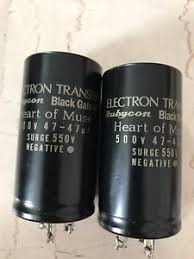
Black Gate WKZ:
47uF + 47uF/500V has a size of 35mm x78mm, bingo, that works! Unfortunately -3uF is missing right at the begin, but I think this is the best cap for this amp.
The 100uF+100uF/500V is 35mmx118mm, so it would work, but does not fit. Only if you remove or cut out the metal top plate and you allow ~10mm slip in of this huge cape into the electronic… So it could work.
Very unfortunate is that it is not produced, while NOS is available on not recommendable prices.
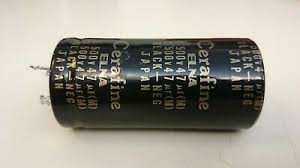
Elna Cerafine:
500V/47uf x 2 35x55mm
500V/100uf x 2 35x112mm
Again something out of production on crazy prices…
Mundorf Mlytic HV
MLSL5002-050 Body dimensions: 35mm (diameter) x 66mm (height). This is what I bought for the amp + power supply.
Mundorf Mlytic HV MLSL5002-040 Body dimensions: 35mm (diameter) x 50mm (height). This is what I bought for the riaa power supply.
SUN audio, Creative Audio non-metalized audio filmcap
Awesome Q values! huge! only for output! Price: 110EUR !
35mm x 121(135) mm.(including solder lugs) See measurement in table below.
JJ TC529 and VNH:
JJ TC529 50 x 50uF /500V Dimensions (D x L): 35 x 52 mm
JJ TC529 100x100uF /500V Dimensions (L x D): 68 x 35 mm.
There is another series (VNH) with higher voltage ratings:
JJ VNH 0505623 series capacitor. 50+50uF, 560V Dimensions (L x D): 50×35 mm.
JJ VNH 1005623 series capacitor. 100+100uF, 560V Dimensions (L x D): : 70×35 mm.
All JJ should work just fine, however never tested, while comments about it is very split.
CE Manufacturing:
Tunerman used C-EC40X3-525 , dimension 1 ⅜”D X 3″H. in the “retarded” unit. So 35x76mm, which is just fine in size, but -20% in the capacitance. Well, it works and the sound is perfect. I guess the 3rd 40uF was used for power supply separation L/R.
The 100+100uF, C-EC100-1-0 500 is too big: 1 ⅜”D X 4″H, so 101mm is the height.
More matching, but different look/series:
32+32uF C-EC32-32-500CE or 50uF + 50uF @ 500VDC, C-EC50-50-500CE, has the same size: 1 ⅜” diameter x 2 3/16 35x57mm
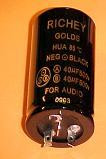
“About RG ( Richey GOLDS ): RG ( Richey GOLDS ) were originally developed for the Japanese audiophile market under the Unicon nameplate. JustRadios is honoured to be able to now offer these audio grade capacitors world-wide. These electolytic capacitors have been specifically designed for use as filter capacitors in power supplies of high-end audio amplifiers. Special features of these audio grade electrolytic capacitors include: ultra low impedance Japanese aluminum foil construction and the use of pure copper solder lugs (coated with a thin tin plating over the copper to protect the base metal from oxidation, thus preserving its solderability). Audio grade means lowest ESR/DF, but most important is an extra internal damping. With Black Gate WKZ capacitors out of production and no longer available at reasonable prices, Richey GOLDS are an excellent alternative. Richey GOLDS are by Richey Electronics Ltd. Richey have been making top quality electrolytics for almost 50 years (since incorporation in Nashville, Tennessee in 1965).”
Available is: 50uF + 50uF at 500 Volts RG Can Ecap with Solder Lugs: 1 3/8 inch dia. by 2 3/4 inch high (35mm X 70mm)
To be honest unsure which Richey is meant, probably this one:
http://www.richey.com.tw/products.php, while this also does not look like the Unicons as the size differs clearly. (The 47+47uF/400V has the same size as the 50+50uF)
Unicon
http://www.acoustic-dimension.com/unicon/unicon-capacitors-main.htm says: “Now the Black Gate WKZ capacitors are no longer available, we have been testing other brands. We found a good sounding replacement in the Unicon 500V capacitors. These Japanese made capacitors are specially designed for AUDIO.” Audio grade means low ESR, low DF etc, but most important an extra internal damping. Well just take a look that currently this has the best measurements, see table. So my current recomendation.
It has the same sizes as Black gate, so also here the 47+47uF could work, while the 100+100uF is to big for the little AG9015 (I mean physical size).
32uF + 32uF 500V 35mm dia X 50mm height. (for preamp)
50uF + 50uF 500V 35mm dia x 80mm height.
100uF + 100uF 500V 35mm dia x 80mm height.
All fit. The cheapest alternative. Did not tested.
K&D:
50+50uF 500V 34x75mm
JiaJia
Philips case DIY caps possibilities:
AN Kaisei in Philips DIY case
Using such requires some DIY. The idea is to use the original Philips metal case and fill it with some fitting caps… Actually 2from these into one housing:
may work, but the nominal voltage is not enough. You need 500V as the operating ~430V is to close to 450V which is dropping performance radically + shortens life way too much.
Non audio version could work:
LGX2H560MELZ25 or LGN2H560MELZ25 56uF 500V 22x25mm
LGX2H101MELZ40 or LGN2H101MELZ40 100uF 500V 22x40mm (smaller sized exists!)
You will need a cap holder:
The old lock solution will not work with a newer cap! Source something like this:
Electrical connection:
If you buy a plastic insulated cap, then you will need to restore the lost electrical connection of the power supply caps negative to the chassis grounding. (C1,C1a, C2,C2a) Please wire the negatives of these capacitors together and wire the last (as this is less noisy!) power supply capacitors negative (C2) to the mass of the house. This will be then the new central grounding, where you should also connect C135, R154 as these points are the least noisy. Perfect for this purpose is the nearest transformer screw. If you replace the preamp capacitor it should also connect to here, but none of the 8uF caps, should be connected as originally. (So close to the chassis GND pin of near circuits.)
If you double the capacity 50uF–>100uF, you should think about to separate the left and right channel. For the power amp this is easy separation, just use double resistors to have the same voltages:
Preamp is tricky as you either put a second capacitor somewhere (as on schematic), or you connect R3, R3′ to the left and right power amp supply (C2, C2a). R13 is in this case still a 10K resistor.
Comparison of caps:
My theoretical (not for every case) preference list is: BG WKZ, AN Kaisei, Elna Cerafine, Unicon, Mundorf Mlytic, F&T. I am working to get all these tested and confirm this ranking. Personally I think that all caps have to be audio grade. The small caps have to have low leakage (Mustards) to block DC and pass just AC, while at the big one’s rather their ESR(Q, D, Teta) counts that it looks like a capacitor also on higher frequencies (Mustard are superior here on all frequencies…). You may say that at the power supply just the 100Hz behavior counts… Well yes, but the last cap supplies the tubes, which pulls electrons from cap according frequency of music, so I believe that the power supply caps do influence the sound very well! And do not believe that new technologies offer more capacitance in smaller size, but without any cost… Just check how these newer caps degrade on higher frequencies, while the old Philips behaves more like a capacitor also at 1kHz. I am preety sure that the physical size helps BG WKZ and also the Unicon cap to perform like a Philips (or even better).
Measurements with the calibrated head (please scroll for details right):






 Philips AG9015
You must be logged in to post a comment.